
 For Individuals
 For Enterprises
 Coaching Matters
 International Coaching Week
 Ebooks
 Podcasts
 Blogs
Blogs Community
Leadership Lessons from David Clutterbuck: Mastering Coaching Maturity for Impactful Leadership
In an era where artificial intelligence (AI) is poised to outperform basic coaching practices, the call for leaders to elevate their skills has never been more urgent. Professor David Clutterbuck, a global authority on coaching and mentoring with over 75 co-authored books, offers a transformative perspective on leadership through the lens of coaching maturity. In a thought-provoking podcast, Clutterbuck shares insights from two decades of research, revealing that 70% of coaches fail to hold meaningful learning conversations, relying instead on rigid models. His framework of coaching maturity—evolving from model-based to systemic eclectic coaching—provides a blueprint for leaders to foster growth, navigate complexity, and create lasting impact. This blog post distills Clutterbuck’s wisdom into actionable leadership principles, organized around key themes of coaching maturity, systemic thinking, and reflective practice, with practical strategies and real-world examples to empower aspiring and current leaders.
Understanding Coaching Maturity: A Leadership Imperative
Defining Coaching Maturity: Beyond Models to Meaningful Conversations
Clutterbuck defines coaching maturity as the evolution from rigid, model-based coaching to a dynamic, client-centered approach that integrates the leader’s identity, wisdom, and systemic awareness. While novice coaches rely on prescribed frameworks (e.g., asking formulaic questions), mature coaches prioritize the client’s success, using themselves authentically to facilitate transformative conversations. For leaders, this translates to moving beyond transactional management to fostering environments where teams thrive through meaningful dialogue and self-discovery.
Real-World Example: Clutterbuck’s early research in 2004, assessing coaches for organizations like Bank of America and the UK’s National Health Service, revealed a startling truth: 70% of coaches couldn’t hold learning conversations, focusing instead on processes rather than client needs. This insight drove his development of the coaching maturity framework, highlighting the need for leaders to prioritize impact over adherence to models.
Actionable Takeaway: Reflect on your leadership approach by asking, “Am I managing processes or fostering growth?” In your next team meeting, focus on asking one powerful question, such as, “What’s the biggest opportunity you see in this challenge?” to spark deeper dialogue and shift from control to collaboration.
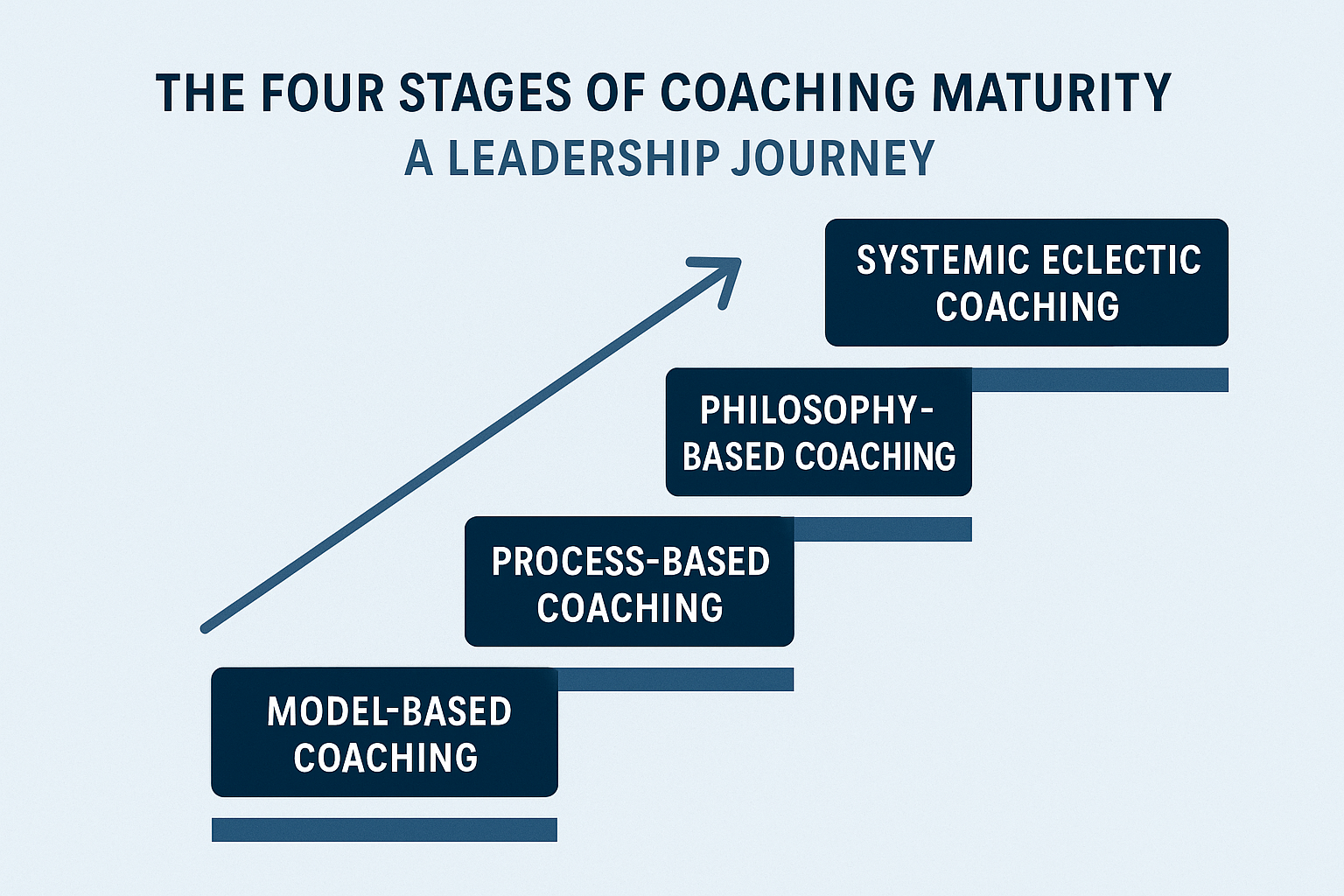
The Four Stages of Coaching Maturity: A Leadership Journey
Clutterbuck’s research identifies four stages of coaching maturity, each reflecting a mindset shift critical for leadership development:
- Model-Based Coaching: Novice leaders rely on a single framework, attempting to fit team members into predefined processes. This stage is marked by a need for control and discomfort with uncertainty.
- Process-Based Coaching: Leaders begin to relax control, incorporating a broader set of tools and allowing team input to shape interactions, though still tethered to structured approaches.
- Philosophy-Based Coaching: Leaders adopt a relationship-based approach, grounding their actions in a broader philosophy (e.g., empowerment) and experimenting with diverse methods to meet team needs.
- Systemic Eclectic Coaching: The most mature leaders operate holistically, focusing on the individual within their broader system (e.g., team, organization, family). They use minimal, high-impact questions and integrate their life experiences to serve others authentically.
Real-World Example: Clutterbuck’s recent research with the Coach Maturity Research Group found that systemic eclectic coaches ask about one-fifth the number of questions compared to novices, yet their questions are far more powerful, driving deeper client insights. This mirrors leadership, where mature leaders empower teams by asking fewer, more impactful questions rather than micromanaging.
Actionable Takeaway: Assess your current leadership stage by reviewing a recent interaction with a team member. Did you rely on a standard process, or did you adapt to their context? To move toward systemic eclectic leadership, ask one question in your next one-on-one that considers their broader system, such as, “How do your team dynamics influence this goal?”
Embracing Systemic Thinking: Leading in Complexity
Shifting from Problem-Solving to Systemic Awareness
Clutterbuck emphasizes that mature leaders adopt a complex adaptive systemic approach, moving beyond linear problem-solution thinking to understand the broader context—team dynamics, organizational culture, and external factors—that shapes challenges. This systemic perspective enables leaders to address root causes rather than applying quick fixes, fostering sustainable growth.
Real-World Example: In a coaching project with a technology organization, Clutterbuck observed a culture of aggression and control among team members, driven by the chairman’s leadership style. Rather than addressing surface-level issues (e.g., improving interpersonal skills), he encouraged coaches to explore the systemic context—how the organization’s culture shaped behaviors—leading to more meaningful interventions.
Actionable Takeaway: Map out the system surrounding a current team challenge, including stakeholders (e.g., peers, managers, clients) and cultural factors. In your next discussion, ask, “How does our team’s environment influence this issue?” Use insights to propose one systemic change, such as adjusting meeting formats to encourage collaboration.
Balancing Sponsor Expectations with Client Needs
Leaders often face pressure from stakeholders (e.g., executives) to deliver quick results, such as improved productivity. Clutterbuck advises contracting with sponsors to address immediate goals while prioritizing the team’s deeper needs. This ensures leaders align short-term wins with long-term transformation, avoiding the trap of superficial solutions.
Real-World Example: Clutterbuck worked with coaches who renegotiated sponsor expectations by involving both the sponsor and client in goal-setting discussions. By asking sponsors, “What will you do to support these outcomes?” coaches shifted responsibility to the system, enabling sustainable change rather than quick fixes.
Actionable Takeaway: In your next project, meet with stakeholders to clarify their expectations, then ask your team, “What’s most important to you in achieving this goal?” Align these insights to create a plan that balances immediate deliverables with long-term growth, such as mentoring a team member to build skills for future challenges.
Cultivating Reflective Practice: The Heart of Leadership Growth
Building Self-Awareness Through Reflection
Mature leaders, like systemic eclectic coaches, invest heavily in reflective practices to enhance self-awareness. Clutterbuck highlights a powerful technique: reflecting on how you feel, how you think, how you feel about your thinking, and how you think about your feelings. This holistic reflection helps leaders understand their biases and emotions, enabling authentic interactions.
Real-World Example: Clutterbuck’s research found that mature coaches spent significant time in reflection, often through supervision or journaling, to understand their role in client outcomes. This mirrors leaders who reflect on their impact, such as a manager who journals after team meetings to identify how their emotions influenced decisions.
Actionable Takeaway: Dedicate 10 minutes weekly to reflective journaling. After a leadership interaction, write down: “How did I feel? What was I thinking? How did my feelings shape my thoughts?” Use insights to adjust your approach, such as staying calmer in high-pressure meetings to foster better team dialogue.
Integrating Compassion Without Judgment
Clutterbuck distinguishes between empathy (feeling for someone), sympathy (feeling glad it’s not you), and compassion (feeling compelled to relieve suffering). Mature leaders practice compassion, connecting deeply with their team’s challenges without slipping into judgment. This fosters trust and creates a safe space for growth.
Real-World Example: Systemic eclectic coaches create energy in the “space between” themselves and clients, driven by compassionate connection. Clutterbuck describes this as a “light bulb” moment, where mutual understanding sparks transformative insights, similar to a leader who listens deeply to a struggling team member to uncover underlying issues.
Actionable Takeaway: Practice compassionate listening in your next one-on-one by focusing entirely on the team member’s perspective without offering solutions. Ask, “What’s the hardest part of this for you?” and reflect their emotions (e.g., “It sounds frustrating”). This builds trust and encourages open dialogue.
Leveraging Wisdom: Authentic Leadership in Action
Three Types of Wisdom: Skinny, Broad, and Meta
Clutterbuck defines three types of wisdom critical for leadership:
- Skinny Wisdom: Expertise in a specific domain (e.g., technical skills).
- Broad Wisdom: Life experiences that shape empathy and perspective.
- Meta Wisdom: The ability to integrate diverse ideas, emotions, and contexts.
Mature leaders leverage broad and meta wisdom, using personal experiences to connect authentically and synthesize complex information to guide teams through uncertainty.
Real-World Example: Clutterbuck’s work with neurodivergent clients, such as those on the autistic spectrum, required coaches to abandon assumptions and adopt the client’s worldview. This mirrors a leader who learns from a diverse team member’s unique perspective to solve a complex problem, enhancing team innovation.
Actionable Takeaway: Identify one life experience (e.g., overcoming a career setback) that shaped your leadership. Share this story in a team meeting to build connection, asking, “What experiences have shaped your approach to this project?” This fosters meta wisdom by integrating diverse perspectives.
Storytelling as a Leadership Tool
Mature leaders use storytelling to inspire creativity and breakthroughs, much like systemic eclectic coaches who share parables to spark client insights. Stories make complex ideas relatable, helping teams reframe challenges and explore new possibilities.
Real-World Example: Clutterbuck notes that mature coaches use stories to enable clients to make associations, unlike novice coaches who rely on rote questions. Similarly, a leader might share a story of navigating a failed project to inspire a team to approach a current challenge with resilience.
Actionable Takeaway: Craft a 2-minute story about a leadership lesson you’ve learned (e.g., adapting to change). Share it in your next team huddle to frame a challenge, asking, “What can we learn from this to move forward?” Encourage team members to share their stories to build collective wisdom.
Overcoming Leadership Challenges
Moving Beyond Model Dependency
A common challenge for leaders is over-reliance on rigid frameworks, akin to novice coaches clinging to models. Clutterbuck’s research debunks the myth that maturity is about doing the same things more effectively; instead, it requires a fundamental shift in mindset, embracing uncertainty and complexity.
Real-World Example: Clutterbuck’s jazz analogy illustrates this shift. Novice leaders play “scales” (rigid processes), while mature leaders improvise like jazz musicians, adapting to the team’s rhythm. This mirrors a manager who moves from enforcing strict protocols to co-creating solutions with their team.
Actionable Takeaway: Challenge one assumption in your leadership approach this week, such as, “I must always have the answers.” In your next meeting, admit uncertainty and ask, “What ideas do you have for this?” to foster collaborative problem-solving.
Staying Ahead of AI and Simplistic Expectations
Clutterbuck warns that AI is surpassing basic coaching models, threatening leaders who rely on transactional approaches. To stay relevant, leaders must embrace complexity, partner with AI as a tool, and focus on human-centric skills like compassion and systemic thinking.
Real-World Example: Clutterbuck’s prediction that AI will outpace basic coaches within five years underscores the need for leaders to evolve. A leader who uses AI for data analysis but focuses on building trust and empathy with their team exemplifies this balance.
Actionable Takeaway: Experiment with an AI tool (e.g., a productivity app) to streamline routine tasks, freeing time for human-centric leadership. Spend 15 minutes weekly mentoring a team member, focusing on their broader context (e.g., career aspirations) to add unique value AI cannot replicate.
Success Stories: Applying Coaching Maturity
Transforming Organizational Coaching
Clutterbuck’s work with global organizations like Bank of America demonstrates how coaching maturity transforms leadership. By training coaches to move beyond models to systemic thinking, he helped leaders address complex challenges, such as aligning team goals with organizational culture, leading to sustained performance improvements.
Actionable Takeaway: Identify one organizational challenge (e.g., low team morale) and apply a systemic lens. Ask, “What cultural or structural factors contribute to this?” Propose one change, such as regular feedback sessions, to address the root cause.
Empowering Neurodivergent Leaders
Clutterbuck’s work with neurodivergent clients highlights how mature coaching fosters inclusive leadership. By understanding their unique perspectives, coaches helped these leaders leverage their strengths, such as pattern recognition, to drive innovation in their teams.
Actionable Takeaway: Engage with a team member whose perspective differs from yours (e.g., generational or cultural). Ask, “How do you see this challenge?” Use their insights to inform a decision, fostering inclusivity and systemic awareness.
Conclusion: A Roadmap for Transformative Leadership
David Clutterbuck’s coaching maturity framework offers a powerful roadmap for leaders to navigate complexity and drive impact. By evolving from model-based to systemic eclectic leadership, leaders can prioritize team growth, embrace systemic thinking, and cultivate reflective practices. Leveraging broad and meta wisdom through storytelling and compassion ensures authentic connections, while overcoming challenges like model dependency and AI competition requires continuous growth. Whether you’re an aspiring or seasoned leader, Clutterbuck’s principles provide actionable strategies to lead with purpose and resilience.
Start your leadership development journey today by reflecting on your current approach. Journal for 10 minutes on, “What assumptions am I holding that limit my impact?” In your next team interaction, ask one systemic question, such as, “How does our team’s environment shape this goal?” Share your progress on LinkedIn using #LeadershipDevelopment to inspire others. How will you embrace coaching maturity to become a transformative leader?