 For Individuals
 For Enterprises
 Coaching Matters
 International Coaching Week
 Ebooks
 Podcasts
 Blogs
Blogs Alchemy
The Scale of Black Money in India
Black money refers to funds generated through illegal activities or legitimate earnings concealed to evade taxes. Different studies provide varying estimates, but the scale is staggering:
- Professor Arun Kumar estimates India's black economy at 60-62% of GDP.
- World Bank figures range between 25-50%.
- Government of India reports hover around 45-47%.
For a $5 trillion economy, even conservative estimates imply massive leakage. Globally, 2-5% of GDP is laundered annually, but the stock of black money—parked in real estate, gold, art, or offshore accounts—sits much higher at 25-30% of the global economy.
This unreported wealth deprives the government of tax revenue needed for schools, roads, hospitals, and defense. The result? Poor-quality infrastructure and suboptimal public services that affect every citizen.
Real-World Examples: PNB-Nirav Modi and Vijay Mallya Cases
High-profile cases illustrate systemic vulnerabilities. The PNB-Nirav Modi scam involved approximately ₹14,000 crores in fraudulent Letters of Undertaking (LOUs). A single deputy manager exploited the disconnect between the bank's SWIFT messaging system and its Core Banking System (CBS) to issue fake guarantees. This allowed funds to be siphoned abroad without proper records.
The fraud surfaced only after the manager retired, highlighting how human elements can bypass even advanced technology. Similar patterns appeared in other bank frauds.
Vijay Mallya and Kingfisher Airlines represent another archetype. Billions in loans were allegedly diverted for personal use and lifestyle expenses rather than operational needs. While some repayments may have occurred, the initial diversion of funds constituted a crime. Mallya's ability to remain abroad underscores challenges in recovering assets without strong bilateral agreements or court orders.
These cases show that black money isn't abstract—it erodes trust in financial institutions and burdens taxpayers when banks are recapitalized.
The Three Stages of Money Laundering
Money laundering typically follows three classic stages, as explained by experts like Abhishek Bali:
- Placement: Introducing dirty cash into the formal economy (e.g., via cash-heavy businesses, shell companies, or small deposits).
- Layering: Obscuring the trail through complex transactions—using SPVs (Special Purpose Vehicles), multiple bank accounts, trade mis-invoicing, or offshore entities.
- Integration: Reintroducing the "clean" money as legitimate income for investments, property, or business.
Simple everyday example: A consultant receives unaccounted cash and invoices a fake "branding fee" of crores, setting it off against legitimate books. Or, funds move through hawala networks, cryptocurrencies, or gaming apps for layering.
Emerging tools like mule accounts (where individuals unwittingly or knowingly lend bank details), NFTs, and betting apps facilitate faster, harder-to-trace operations.
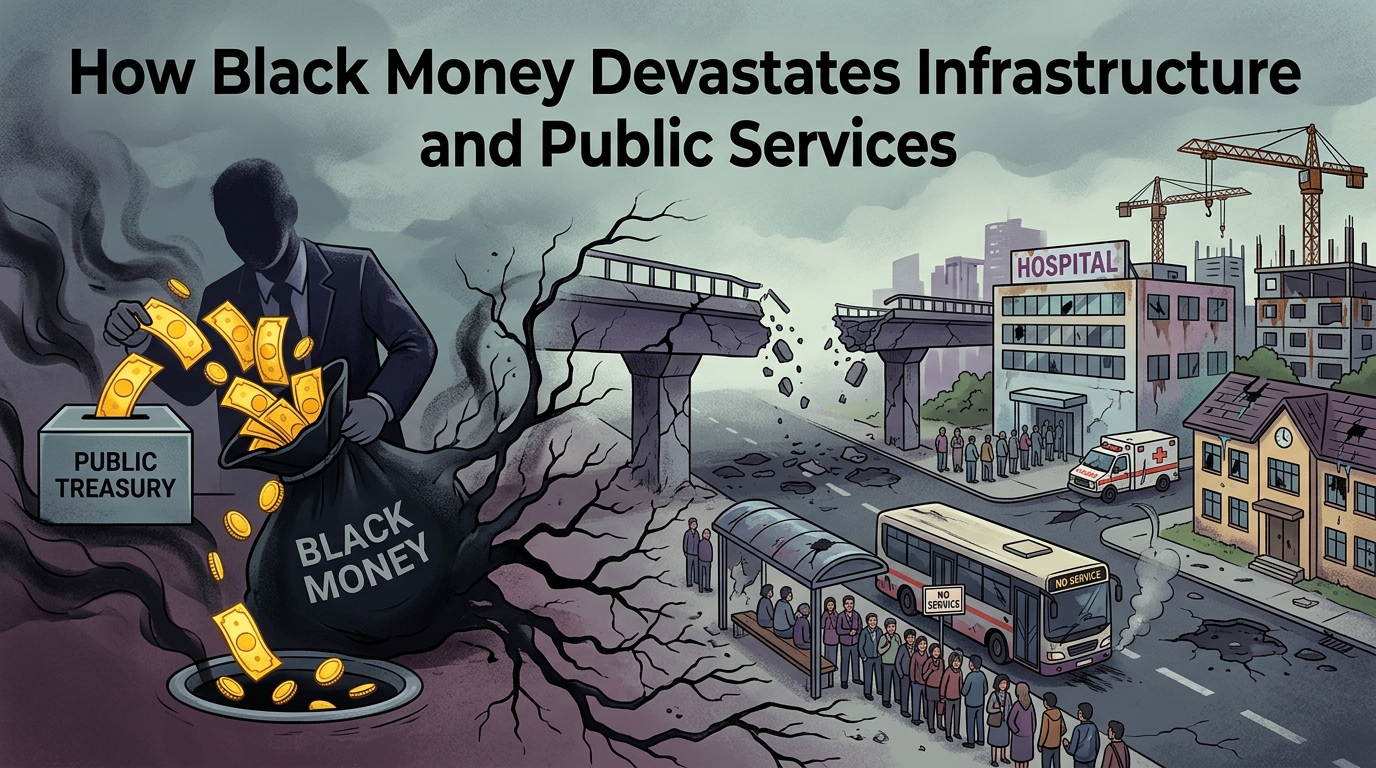
How Black Money Devastates Infrastructure and Public Services
Black money creates a vicious cycle of corruption and underfunding. Contractors often pay 40-50% kickbacks on public projects, leading to substandard materials and shoddy execution.
- Roads and Highways: Poor quality leads to frequent accidents and higher maintenance costs. Funds meant for durable construction vanish into bribes.
- Schools and Education: Leakages mean fewer quality facilities, underpaid teachers, and outdated resources—directly impacting human capital and long-term growth.
- Broader Economy: Reduced tax collections limit spending on healthcare, security, and welfare. It distorts markets, encourages wasteful consumption, widens inequality, and fuels inflation.
As Bali notes, it's often called a "victimless crime," but second- and third-order effects—crashes on bad roads, underfunded schools, and weaker defense—hurt ordinary citizens the most.
Elections: The Biggest Consumer of Black Money
Elections represent the largest demand driver for black money. India holds elections almost year-round across multiple tiers (Lok Sabha, state assemblies, panchayats, etc.), with roughly 1 crore candidates contesting over a 5-year period.
Official spending limits (e.g., ₹95 lakh for Lok Sabha in some areas) are unrealistically low compared to actual costs—buses, food, cash handouts, social media, and voter inducements. Political parties face no such strict caps on expenditures, and donations often flow through loopholes like cash or shell companies.
This creates a perpetual cycle: Businesses generate black money, which funds campaigns, which in turn influences policy and enables more rent-seeking.
Role of NGOs, Trusts, and Emerging Threats
India has over 3.6 lakh active trusts and foundations. While many perform genuine work, some serve as vehicles for laundering via foreign contributions (under FCRA) or domestic diversions.
Terror financing, fake currency, and insurgency funding also integrate into the economy through the same placement-layering-integration process. Modern threats include:
- Online gaming and betting apps (e.g., Mahadev app scam involving thousands of crores routed via crypto).
- Cryptocurrency for cross-border transfers.
- Digital scams targeting vulnerable seniors via urgency tactics and mule accounts.
Government Initiatives and Their Impact
India has made significant strides in digital infrastructure:
- Aadhaar, PAN, GST, and Jan Dhan have improved traceability and inclusion.
- Demonetization (2016) brought cash into the system for scrutiny, accelerated digital payments (UPI), and provided investigative leads—though execution had challenges for cash-dependent small businesses.
- PMLA (Prevention of Money Laundering Act), Black Money Act, and FATF compliance strengthen anti-laundering frameworks.
- Enhanced international cooperation for asset recovery.
Zygram and similar AML (Anti-Money Laundering) tech use AI for transaction monitoring and suspicious activity reporting to FIU-IND.
Challenges remain: No system is foolproof against determined actors, and over-regulation risks stifling legitimate activity. It's a "whack-a-mole" game requiring continuous vigilance.
Black money isn't just lost revenue—it's a direct assault on India's schools, roads, economy, and democratic fabric. From massive bank frauds to election funding and everyday scams, its tentacles reach every sector. Yet, digital reforms, stricter enforcement, and public awareness are tilting the balance toward transparency.
Greater financial literacy, support for ethical businesses, and citizen vigilance can amplify these efforts. Demand accountability from leaders and report suspicious activities.
What are your thoughts on black money's impact? Share in the comments, subscribe for more insights on India's economy and governance, and share this post to spread awareness. Together, we can push for a cleaner, stronger India.