
 For Individuals
 For Enterprises
 Coaching Matters
 International Coaching Week
 Ebooks
 Podcasts
 Blogs
Blogs Alchemy
Aryan Khan, Aarushi Talwar & MJ Akbar | India's Top Lawyer Finally Speaks
In the high-stakes world of Indian criminal law, where bail in high-profile cases India often sparks national debate and media trials shape public opinion long before verdicts are delivered, one of the country’s most respected senior advocates pulls back the curtain. From the controversial arrest of Aryan Khan to the media frenzy around the Aarushi Talwar murder case and the MeToo allegations against MJ Akbar, this candid conversation reveals the uncomfortable truths about flaws in India's criminal justice system, power imbalances, judicial delays, and the human cost of prolonged litigation. Drawing on decades of courtroom experience, the lawyer offers rare insights into why liberty matters, how evidence can be weaponized or withheld, and what ordinary citizens can do when caught in the system. Whether you’re concerned about judicial accountability and delays in India or seeking a legal perspective on MeToo movement in India, this deep dive delivers actionable wisdom and systemic critique that every informed citizen needs to hear.
The Unequal Temple of Justice: Power and Privilege in Indian Courts
India’s justice system proudly upholds the principle that all are equal before the law. Yet, as India’s top lawyer candidly admits, people with power and money often have a clear edge in navigating the temple of justice. The ability to hire the strongest legal teams, file multiple petitions simultaneously, and secure swift remedies like bail creates a two-tiered reality.
Wealthier litigants can afford senior counsel whose reputation commands judicial attention in time-constrained hearings. In contrast, ordinary citizens may wait years for basic relief. The lawyer emphasizes that one right cannot justify five wrongs—fast bail for the privileged should set a precedent for everyone, not become an exception reserved for the influential. This disparity is especially visible in bail in high-profile cases India, where public scrutiny amplifies perceptions of favoritism.
Senior advocates also benefit from credibility built over decades, giving their arguments slightly more weight in fast-paced proceedings. The solution? Stronger training mandates for young lawyers and greater emphasis on judicial accountability and delays in India so that merit, not money or connections, drives outcomes.
High-Profile Cases That Exposed Systemic Flaws
The conversation spotlights three landmark cases that captivated the nation: Aryan Khan’s drug-related arrest, the Aarushi Talwar double murder, and MJ Akbar’s defamation battle amid MeToo allegations.
In the Aryan Khan matter, questions arose about rapid bail grants for some versus prolonged detention for others. The lawyer stresses that bail disparities in high-profile cases India highlight a deeper issue: pre-trial incarceration should never become default punishment simply because trials drag on.
The Aarushi Talwar case stands as a textbook example of media trials impact on Indian justice. Social media and television outlets relentlessly condemned the family until a film offered a counter-narrative. The investigative agency itself flip-flopped on theories, yet public opinion had already delivered its verdict. Only the family knows the full truth, but the episode proves how flaws in India's criminal justice system allow media to damn reputations long before courts speak.
Similarly, the MJ Akbar case—still sub judice at the time of discussion—underscored the power of social media accusations. The lawyer notes that allegations surfacing years later leave the accused “blindfolded and boxed” with no reliable recall or evidence to defend themselves.
Bail, Liberty, and the Dangers of Pre-Trial Detention
Liberty is the rule, not the exception. Denying bail because “the trial will take ten years” is, in the lawyer’s words, pre-trial justice by punishment—a fundamental perversion of due process. Courts must prioritize speedy trials, but until that happens, prolonged detention cannot substitute for justice.
The discussion reveals how prosecution sometimes withholds exculpatory material, keeping accused persons behind bars unnecessarily. Judges must intervene decisively when the state suppresses evidence. The lawyer argues passionately: just because the system is slow does not mean an innocent person should lose even one extra day of freedom.
This principle ties directly into broader judicial accountability and delays in India. With over five crore cases pending nationwide, undertrials languish while powerful litigants secure relief. Creating an intermediate court between High Courts and the Supreme Court, alongside genuine accountability for judicial performance, could ease the burden.
Media Trials vs. the Sanctity of Due Process
India lacks the jury sequestration system used in the West to shield fact-finders from media influence. Judges, being human, are exposed to the same relentless coverage. The lawyer references Lord Denning’s powerful observation: media should only intervene when it believes victims are suffering injustice, not conduct parallel investigations or deliver verdicts.
Police appearing on television to deliver lectures and “bhashans” about ongoing probes further poisons the well. Such conduct undermines the presumption of innocence. In high-stakes matters, media trials impact on Indian justice often creates irreversible reputational damage that no acquittal can fully repair.
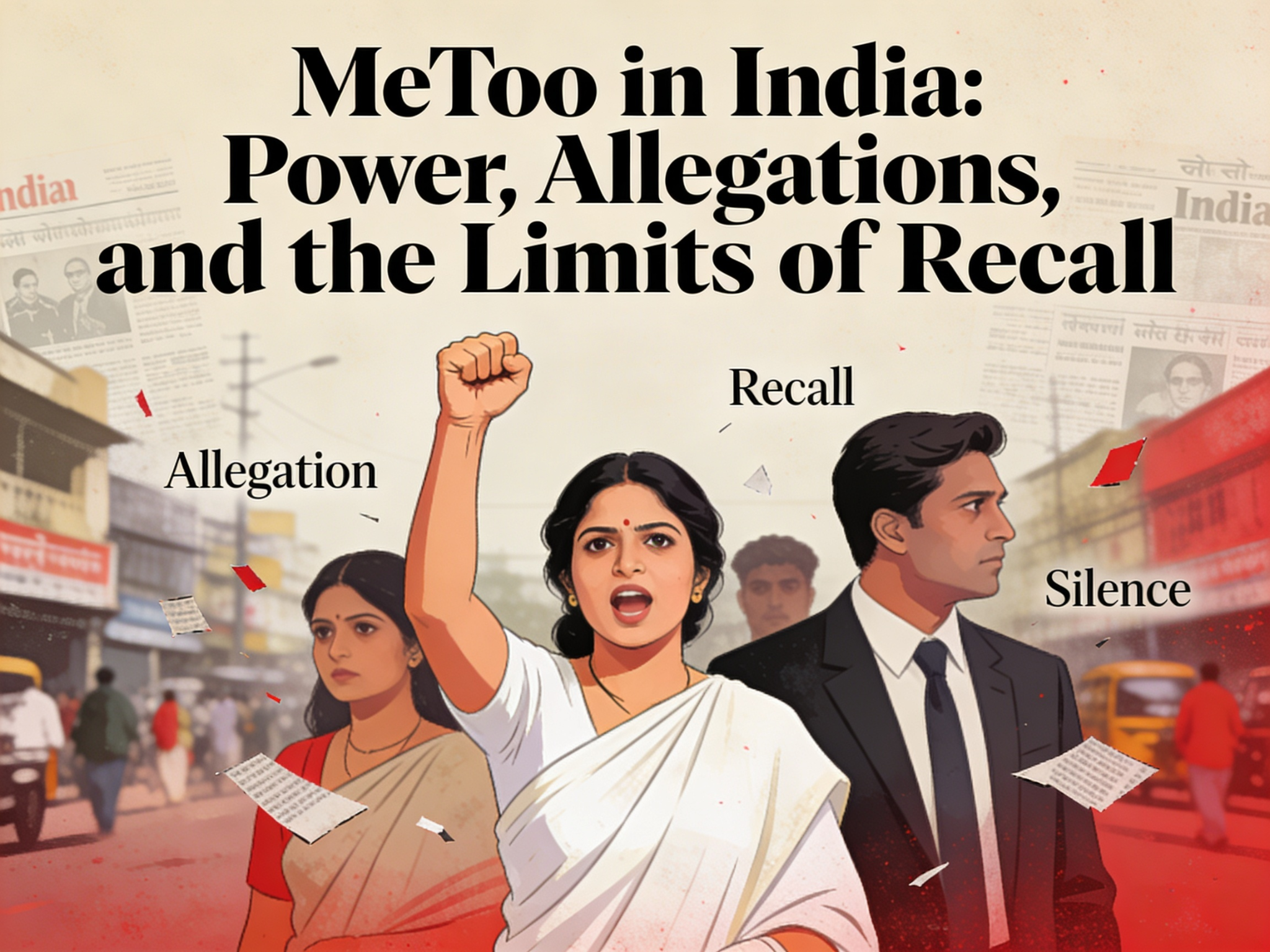
MeToo in India: Power, Allegations, and the Limits of Recall
The MeToo movement was a necessary reckoning against abuse of authority. Yet the lawyer offers a nuanced legal perspective on MeToo movement in India: while robust laws (Section 354 IPC, POCSO, Vishaka Guidelines, and the 2013 POSH Act) already existed, non-contemporaneous allegations pose unique challenges.
Memory fades. After a decade, precise recall of dates, times, and contexts becomes nearly impossible. The accused faces an uneven battlefield—social media accusations spread instantly, but defenses require concrete evidence that may no longer exist. The lawyer advocates for gag orders, time-bound complaints, and robust civil defamation remedies rather than relying solely on criminal provisions.
Criminal defamation remains in the statute book partly because civil remedies are slow; reforming timely civil redress could reduce misuse while protecting genuine victims.
Police Investigations, Evidence Disclosure, and the Call for Scientific Justice
Poor investigations plague the system. Courts repeatedly note “flawed” or “inadequate” probes, yet rarely hold officers accountable. The lawyer calls for scientific, forensic-driven investigations—DNA testing, video evidence, mobile records, brain mapping—applied uniformly, not just in high-profile cases like Nirbhaya.
Prosecution must disclose all material, including that which exonerates the accused. Withholding evidence should invite strict consequences. The new criminal laws provide limited preliminary inquiry windows for certain categories (commercial, matrimonial), but broader reforms are needed: better-trained police, independent forensic labs, and consequences for perjury or suppression of evidence.
Conviction rates hover around 42-54% depending on the year and category (significantly lower for rape cases), which the lawyer views positively—it demonstrates that innocent people are still being acquitted despite systemic pressures.
Practical Advice for Victims and the Falsely Accused
For the falsely accused:
- Preserve contemporaneous evidence: WhatsApp chats, call logs, location data, and mobile records form the strongest alibi.
- Freeze and clone devices early to prove searches, communications, and timelines.
- Secure witnesses and, where possible, a media strategy plus gag order.
- File for quashing or discharge if material is withheld.
For victims of crime:
- Report as soon as possible—delay requires strong explanation.
- Preserve all evidence; deleting messages or records can backfire.
- Document reasons for any delay in complaint.
The lawyer also explains core procedures: an FIR registers the cognizable offence; investigation follows (including possible preliminary inquiry); and chargesheet is filed once evidence is gathered. Zero FIRs now allow filing at any police station nationwide.